


Commentary
Camille Ammoun
{
  "authors": [
    "Camille Ammoun"
  ],
  "type": "commentary",
  "blog": "Diwan",
  "centerAffiliationAll": "",
  "centers": [
    "Carnegie Endowment for International Peace",
    "Malcolm H. Kerr Carnegie Middle East Center"
  ],
  "collections": [],
  "englishNewsletterAll": "",
  "nonEnglishNewsletterAll": "",
  "primaryCenter": "Malcolm H. Kerr Carnegie Middle East Center",
  "programAffiliation": "",
  "projects": [
    "The Climate Crisis, Resilience, and Displacement in the Middle East and North Africa"
  ],
  "regions": [
    "Lebanon"
  ],
  "topics": [
    "Climate Change"
  ]
}
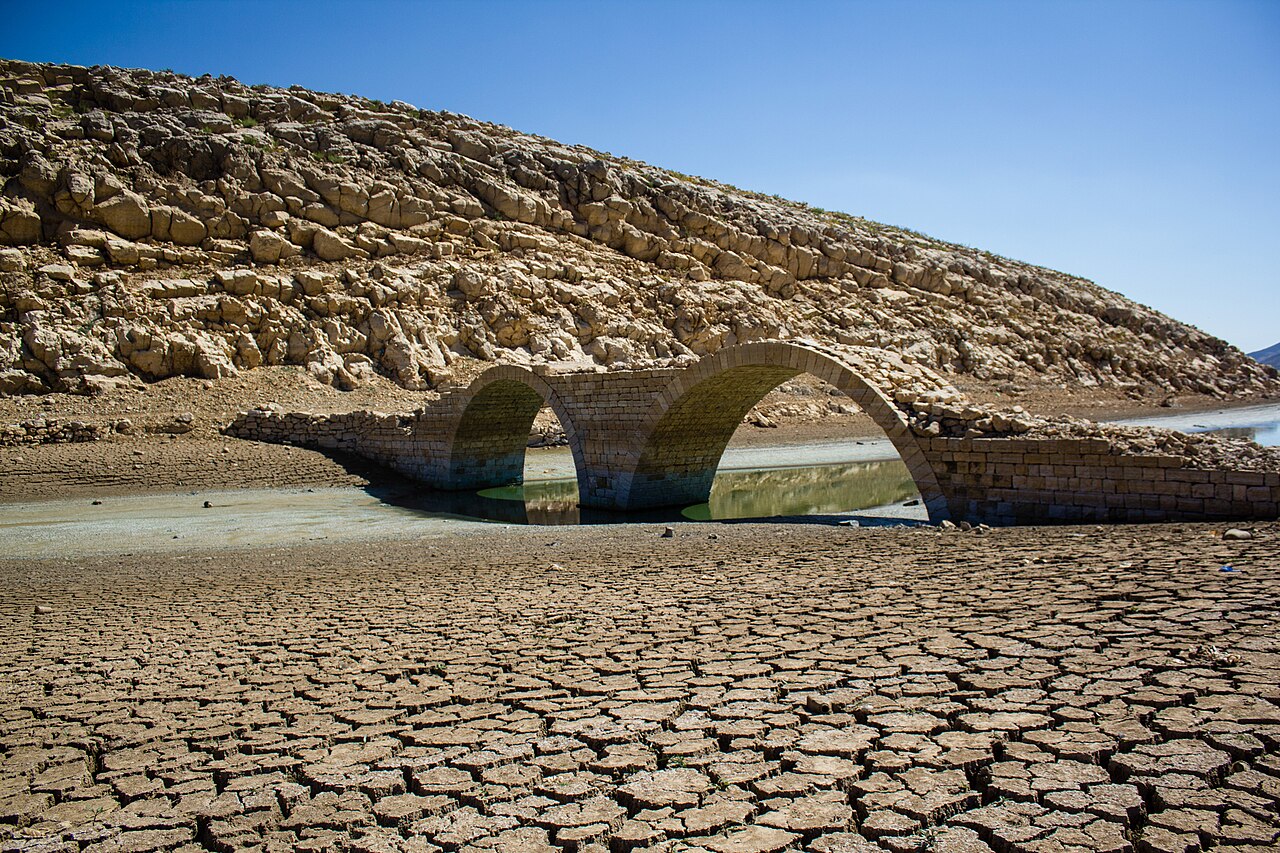
Source: Amal Charif (Creative Commons CC-BY-SA-3.0)
Lebanon’s largest water reservoir is a house of many mansions when it comes to converging failures.
Climate change is rarely the single factor driving migratory pressures in vulnerable communities. Governance failures, pollution, economic crises, and conflict often interact with climate impacts in ways that are increasingly difficult to disentangle. The Litani basin in Lebanon offers a stark illustration of how these forces converge to shape patterns of mobility.
The Litani River rises near Baalbek and flows through the Beqaa Valley, before bending westward toward the Mediterranean where it meets the sea north of Tyre. It cuts across one of the most fertile areas of the Levant, forming a reversed L-shaped basin vital to Lebanon’s agricultural and water systems. At its center lies the Albert Naccache Dam, which forms Lake Qaraoun, the country’s largest water reservoir. Built in 1959, the dam was designed to support irrigation and hydropower and supply drinking water.
In this rural area of the Beqaa, multiple crises overlap today. These include repeated droughts, water pollution, the environmental impacts of endemic corruption, but also, at Lebanon’s national level, economic collapse. The region also suffered heavily from bombardment during the conflict between Israel and Hezbollah in 2024, and in the most recent conflict of 2026. Such compounded pressures have reshaped livelihoods and narrowed the range of adaptation measures available to communities around the lake, including their mobility.
Quantifying the migratory pressures is difficult, however, as data for the West Beqaa are limited and population movements are gradual and overlapping. The area is characterized by layered mobility patterns that include the slow outmigration of local residents, the shifting movements of Syrian refugees, and today mass displacement because of the ongoing Lebanese conflict.
In summer 2025, Lebanon experienced its most severe drought on record following one if its driest winters in 40 years. Rainfall dropped by more than half, while reduced snowpack and earlier melt further constrained water availability. The Beqaa was among the regions hardest hit. Around a quarter of wells dried up and springs were depleted. Lake Qaraoun recorded its lowest water inflow since the construction of the dam, falling to 45 million cubic meters, which was far below the annual average of 350 million. This allowed the sunken 18th-century Saghbine Bridge to reemerge as a visible marker of hydrological stress. The bridge was also visible during the drought of 2014.
Droughts and desertification are widely recognized as powerful drivers of migration. Following the 2025 drought in the Beqaa, 15 percent of farmers were forced to abandon their crops. As one potato farmer in the region put it: “We’re holding on because it’s our land, and we don’t want to leave it. But until when?”
The drought of 2025 amplified vulnerabilities across sectors, with cascading effects on communities. Declining agricultural output eroded already strained food security, while livestock losses and falling crop yields drove up food prices and deepened rural poverty. The sharp rise in the cost of hay and animal feed increased the price of meat and dairy products, further straining household budgets. While reduced hydropower availability constrained energy supply, growing water scarcity intensified social tensions. Protests, disputes, and occasional violence reflected the growing competition over unequal water access.
At the same time, Lake Qaraoun has faced severe environmental degradation. Untreated municipal and industrial wastewater, agricultural runoff, and solid waste have rendered large parts of the lake unsafe. High concentrations of bacteria, organic pollutants, and toxic metals have restricted its use, even for irrigation. In 2021, more than 100 tons of fish died in the lake, underscoring the scale of the collapse in the basin’s ecosystem. Pollution has compounded the effects of drought, reducing incomes and living conditions, exacerbating public health issues, and acting as a multiplying factor for migratory pressures on affected communities.
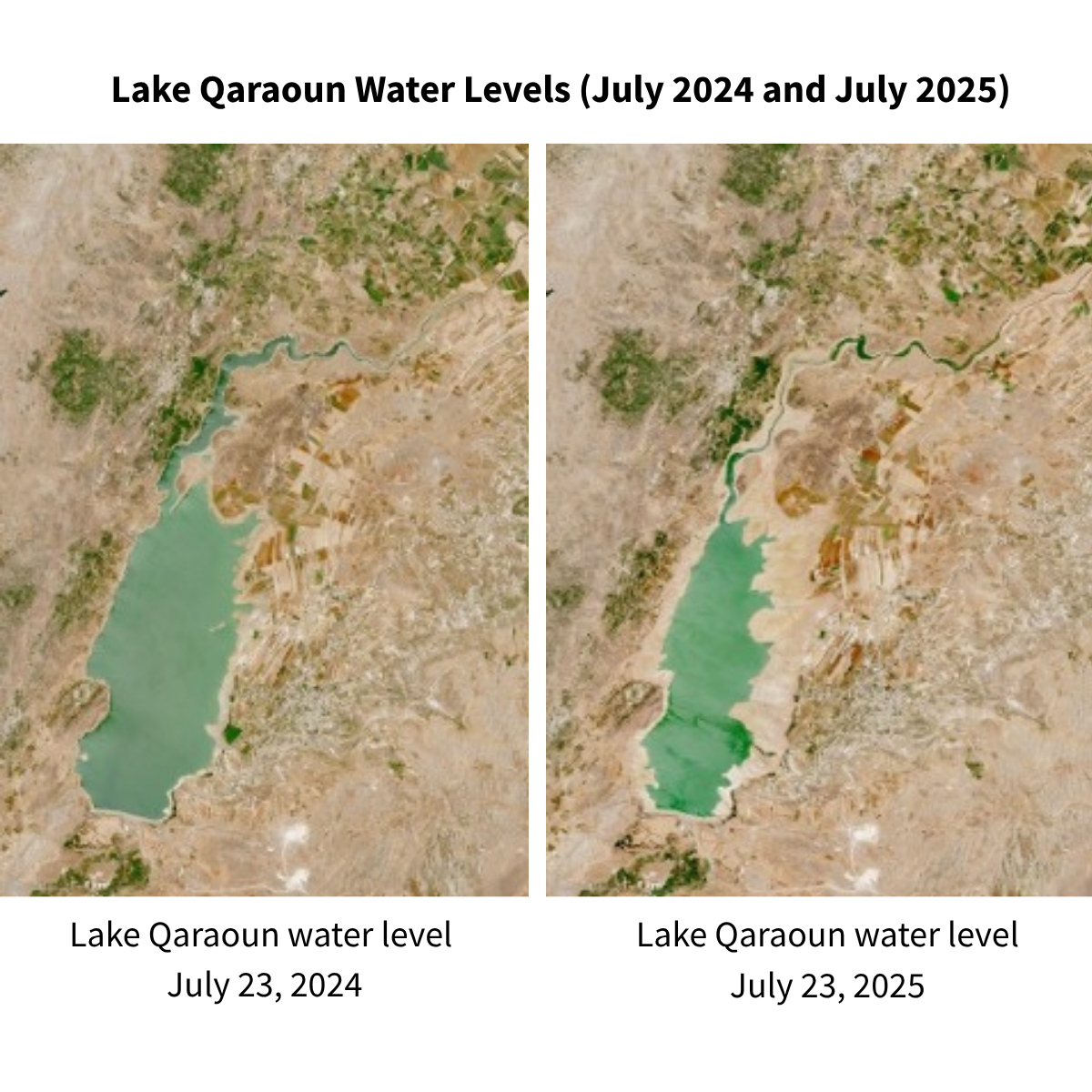
Credit: European Union, contains modified Copernicus Sentinel Data 2026
Pollution in the Litani River basin is being driven by systemic governance failures that have allowed contamination to persist, despite repeated mitigation efforts. Fragmented responsibilities, weak enforcement, chronic underinvestment, and endemic corruption have eroded accountability, delaying projects, allowing for the misallocation of funds, and ensuring that projects are captured by vested interests. As the director general of the Litani River Authority, Sami Alawieh, has noted, “The main problem is that private interests are prioritized over the public interest.” By deepening environmental stress in already fragile communities, the governance failures directly shape migratory pressures on the river’s communities.
These institutional weaknesses have been further exacerbated by Lebanon’s economic collapse. Since 2019, the sharp depreciation of the Lebanese pound has driven up the cost of agricultural inputs such as fuel, fertilizers, seeds, and pesticides, pushing many farmers back to subsistence and deepening poverty. In addition, access to loans became impossible due to the banking sector collapse. In response, migration patterns have shifted, with younger residents seeking work abroad or moving to cities, further weakening the Beqaa’s productive base.
These structural pressures have been repeatedly intensified by conflict. During the 2024 war between Hezbollah and Israel, airstrikes and calls for evacuation forced around 1.2 million people to leave their homes across the Beqaa, South Lebanon, and Beirut’s southern suburbs. A similar pattern has unfolded again in 2026. On April 4, the vicinity of Lake Qaraoun was struck several times. Villages such as Sohmor, Yohmor, and Mashghara were bombed by Israeli aircraft, and an Israeli drone hit a car 400 meters away from the Albert Naccache Dam. While the 2024 war disrupted agriculture by restricting access to land, damaging crops and assets, displacing farmers, and breaking input and labor supply chains, the 2026 war is likely to produce similar, if not more severe, effects.
While climate change, governance failures, pollution, economic collapse, and war all contribute to migratory pressures, their effects are so deeply intertwined that isolating any single factor risks confusing the dynamics at play. Migratory pressures are increasingly understood as the result of complex configurations of interdependent and interacting factors rather than the result of a single identifiable root cause.
There are no clear-cut solutions for this level of complexity, which is reflective of a broader global polycrisis, especially when conflict is added to the mix. However, the case of Lake Qaraoun, where these crises converge, suggests that the challenge is not to disentangle these pressures, but to understand how they reinforce one another, and to design policies that can manage their convergence. This requires moving beyond fragmented, sectoral responses and toward integrated approaches that address and link climate, water, agriculture, the economy, and corruption, while shifting from reactive crisis management to anticipatory governance that incorporates mobility into adaptation strategies.
This work is licensed under a Creative Commons Attribution 4.0 International License.
For more details regarding the license deed, please visit: CC BY 4.0 Deed | Attribution 4.0 International | Creative Commons.
Former Nonresident Scholar , Malcolm H. Kerr Carnegie Middle East Center
Camille Ammoun was a nonresident scholar at the Malcolm H. Kerr Carnegie Middle East Center. His research focuses on climate change, political economy, and urban development.
Recent Work
Camille Ammoun
Camille Ammoun
Carnegie does not take institutional positions on public policy issues; the views represented herein are those of the author(s) and do not necessarily reflect the views of Carnegie, its staff, or its trustees.
Lying at the heart of Lebanon’s dysfunction is an inability to secure accountability and institutional legitimacy.

Maha Yahya
In an interview, Sohaib Jawhar analyzes the profound changes in the ties between the neighboring countries.

Michael Young
Any move by the United States to make good on Trump’s suggestion that Washington persuade Damascus to confront Hezbollah militarily would have catastrophic consequences.
Kheder Khaddour
As talks begin between Washington and Tehran, Beirut has an opening to advance a regional plan for the party’s disarmament.
Michael Young
In an interview, Elizabeth Thompson recalls how the country formulated a liberal constitution in 1920, before being denied by France and Britain.
Michael Young